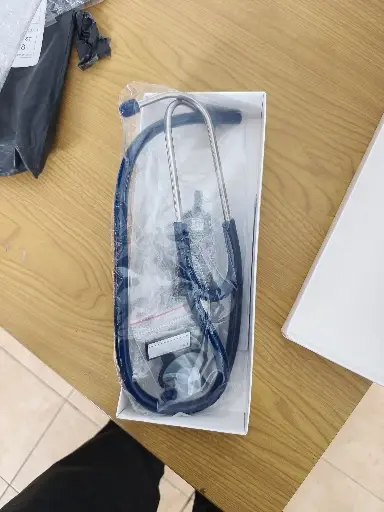
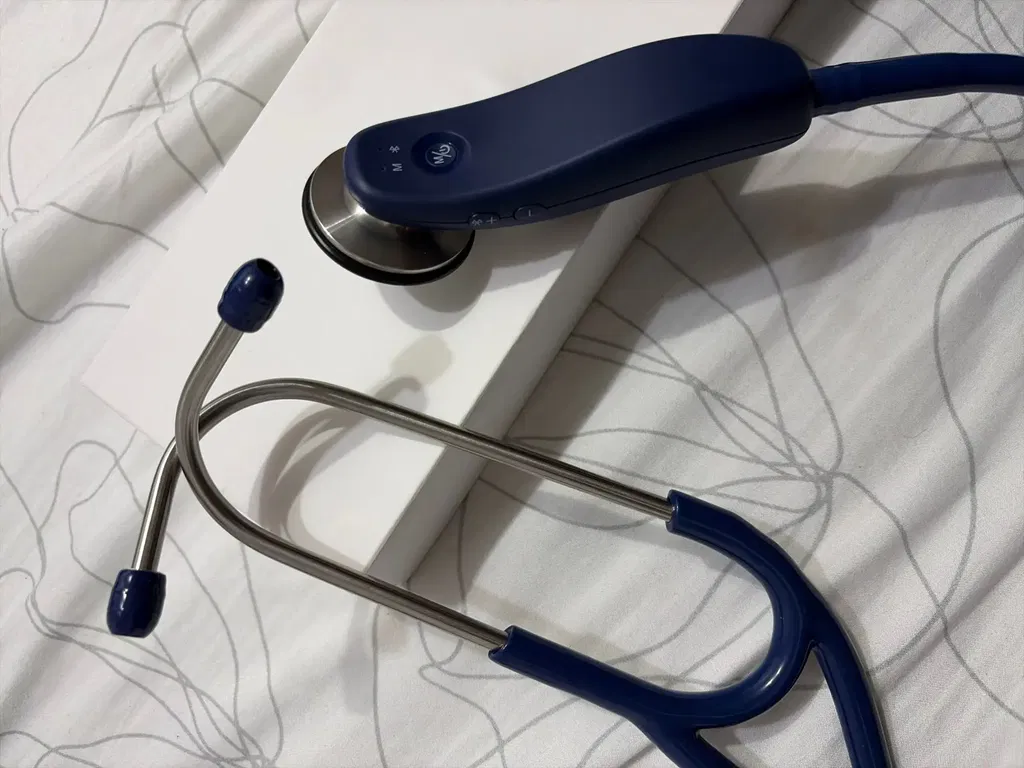
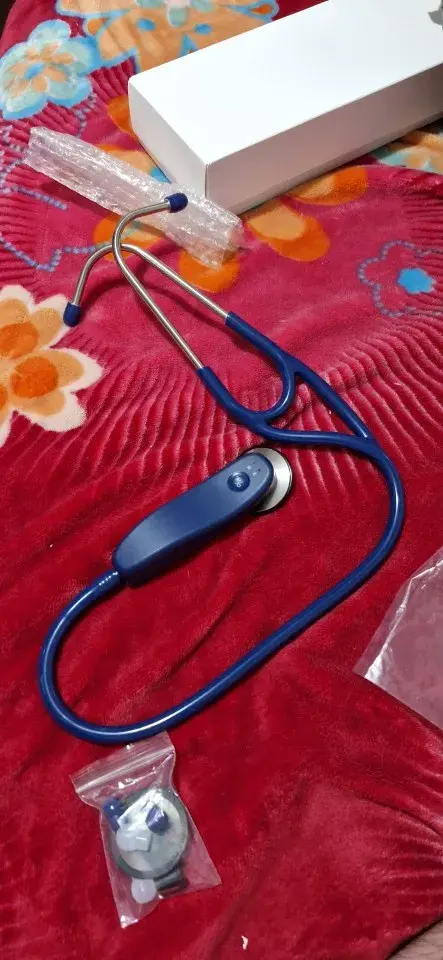
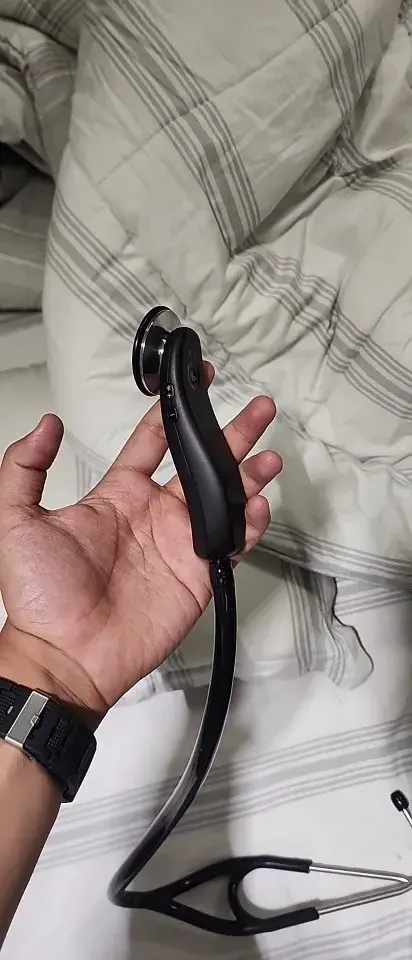
Good quality, just needs to work well; overall a good product although it took a while to arrive.
Gaston P.


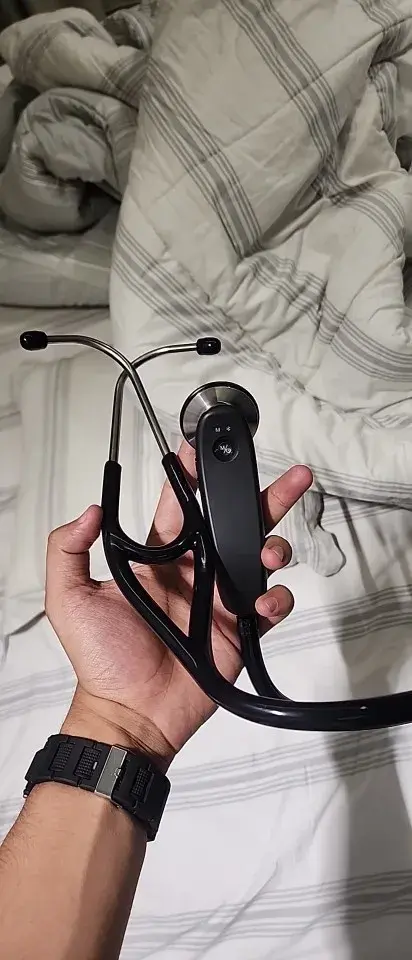
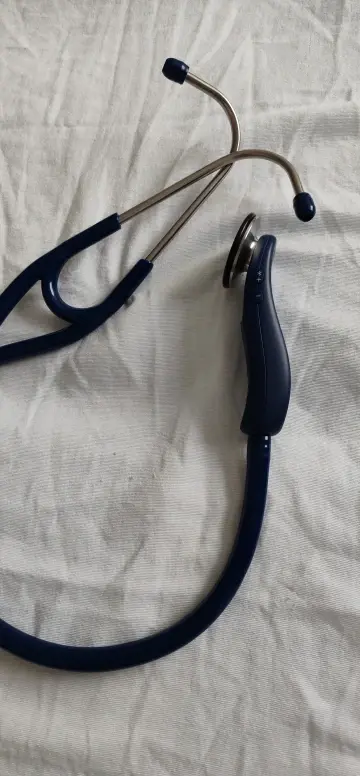
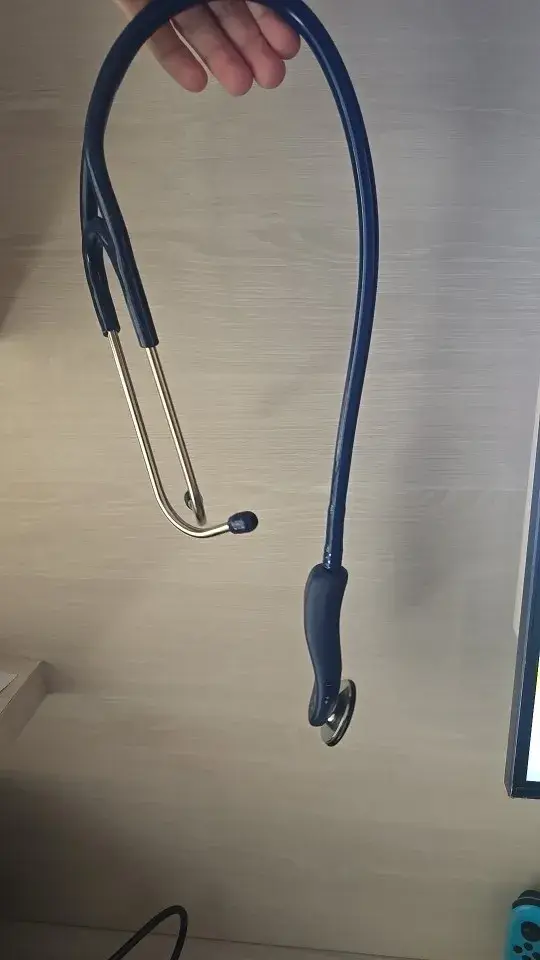
Premium Bluetooth Digital Stethoscope – Wireless 40x Amplified Sound with OLED Display

Free UK delivery on every order. No minimum spend.
Dispatch: 1–3 working days.
Delivery: 5–18 working days after dispatch.
Returns: 30-day returns window. A 15% restocking fee applies to change-of-mind returns; faulty or incorrect items are refunded in full. Your 14-day statutory right to cancel is unaffected. Full returns policy
Good quality, just needs to work well; overall a good product although it took a while to arrive.
Gaston P.
Sounds good
Corrinne M.
Very good options
Sam
As a paramedic, it’s hard to hear in the back of an ambulance when trying to listen to lung sounds. These work great.
David H.H.
great product
kemar
The ultimate upgrade for anyone studying in healthcare — or the most impressive tech gift for someone who is. This Bluetooth-enabled digital stethoscope delivers 40x sound amplification, active noise cancellation, and real-time waveform visualization through a smartphone app (iOS & Android compatible). An OLED display shows live BPM readout, battery status, and volume level at a glance.
Switch between Bell and Diaphragm modes with a single button press. Connect wirelessly to record, save, and review audio with crystal clarity. Rechargeable lithium-ion battery delivers up to 60 hours of use per charge.
Good quality, just needs to work well; overall a good product although it took a while to arrive.
Sounds good
100% recommended, attentive and friendly seller, I was able to connect on my phone right away. Very superior and high-quality sound. I would buy again.
It does not have a support application, the sound quality is average.
Beautiful and the sound is clear.
Uses 2 AAA batteries, only sounds when turned on. For normal use with the application, it takes time to use good materials, a bit longer and thicker but it works.
I arrive in optimal condition, still waiting to see if it works. Fast shipping
great product
As a paramedic, it’s hard to hear in the back of an ambulance when trying to listen to lung sounds. These work great.
Very good options
Phenomenal amplification and clarity! Excellent quality as expected from Littmann.
Amplifies sound, and can connect to iPhone for better analysis and saving recordings
Love my Littmann. I work in a noisy and chaotic ER where it’s not always easy to make out good heart sounds. The Littmann makes it ALOT easier.
Amazing how much better I can assess my patient now
Quality great, easy to use, durability
It’s worth every penny, my classmate all want to use because it gives the accurate number.
Works absolutely well, and I love the silencer feature too. You won’t regret this purchase, and it’s worth the price, too.
The media could not be loaded.
So far, it looks and feels great. I'm HOH so I needed something I can amplify sound with. I had a budget, so it was important to stay below a certain number but still have something good and effective. I have not taken this to work yet, but trying it at home, it met my expectations. I did compare it to my basic stethoscope and the difference is night and day. I can definitely hear better from this. I don't know if I'll use the smart features, but I do hope there is a way to adjust volume gradually instead of the button going regular to loud. We'll see. Its very stylish and professional looking. It feels durable. The black color was affordable compared to competitors who charge more for a solid color. I didn't receive any incentives but I do recommend this product.
I have had this stethoscope for almost 2 years and use it in the field as a Paramedic. This is not a bad stethoscope by any means, however, given the demanding environments EMS works in it doesn’t work as well as I had hoped.Its durability in my case on the ambulance is lack luster. I have had to replace the diaphragm covers 3 times and the core piece is cracked. This thing gets beat up pretty good but so did my other stethoscopes like my classic III that I used before and I never had any problems. This may just be a me problem and not Littman problem but maybe not.The noise cancellation was the feature I was looking forward to the most. Listening to lung sounds is critical in patients with respiratory pathologies or trauma. With that said it can be difficult to hear with road noise or sirens in the background. In my experience this feature was a huge let down for me, it says that it blocks out sound and makes the lung sounds louder and for me it works great on scene prior to departure but during transport all it picks up is road noise forcing me use the crappy stethoscope that my service provides.The portability isn’t that great for a couple reasons. I don’t wear it around my neck because I find it tacky, uncomfortable and a safety hazard. It doesn’t fold at all to fit in a pocket in my pants so I end up leaving it in the Ambulance or on the back of the stretcher.I think this is a great device for someone in a controlled environment such as the ED, ICU or a clinic but for EMS it isn’t very suitable or effective. With how poorly EMS is compensated it only exacerbates the steep price tag that comes with this particular stethoscope.
Being a retired Professional Firefighter, I know how difficult it can be to clearly hear faint sounds from a stethoscope in noisy environments. I used a Littman Cardiology ll throughout my career, and even with a high quality stethoscope, it was challenging for me to always be able to hear well.When my daughter who is a Paramedic put this on her Christmas list, I knew she would benefit greatly by having an amplified set of ears.She was thrilled when she opened this present!!! 😀She has only worked a few shifts since Christmas, but she already says she’ll never be without her amplified Littman!We both highly recommend this stethoscope!!! 😀
The positive: 1. Light, compact form factor, 2. Comfortable ear pieces, 3. Surprisingly good sound quality even without amplification, 4. 40X amplification and noise-canceling works well.Could be improved: 1. Instrument is absolutely unfriendly to hearing aids: earpiece does not occlude the ear canal when hearing aids are in place, so noise-canceling is ineffective and much of the benefit of the amplification is lost. •Provide an optional accessory: over-the-ear headphones (either a modern mechanical ear trumpet or electronically amplified) the earpieces could plug into for users with hearing aids. •Better yet, enable the Bluetooth to pair with and transmit real-time audio signal directly to a user’s hearing aids. That way, a user could keep the steth around their neck and still get great auscultation. It’s not rocket science, given that the Core already digitizes the audio signal and sends it via Bluetooth to the user’s cell phone. Having a patient’s heart & lung sounds audible in my hearing aids could be an enhanced feature I WOULD be willing to pay a monthly fee for. 2. The main purpose of the built-in Bluetooth communication with cell phone is to get us to subscribe—for a monthly fee—to a service most physicians don’t need. How many doctors need to send an audio file of heart sounds to anybody? By the same token, attaching the audio file of a patient’s heart/lung sounds to an EMR would provide legal evidence that the physician actually did examine the patient (or at least the chest). •Put the Bluetooth to good use for something physicians actually want: hearing heart sounds better. Enable the Core’s Bluetooth to pair with user’s hearing aids. Also, enable multiple channels of simultaneous Bluetooth receivers, so supervising physicians could have residents and medical students listen in for teaching purposes. Likewise, were universal Bluetooth pairing enabled, a Bluetooth speaker could be used for teaching in the (relatively quieter) classroom setting. I would pay a monthly fee for this capability. 3. The charging port is micro-USB, an inconvenient and obsolete connector, making the Core Steth out of step with everything else in my home and office. •Get with the times, Littmann. Change the charging port to USB-C. 4. The 40X amplification is good, but still inadequate. Evan at 40X, it’s difficult to hear subtleties of auscultation in a noisy ER or a busy private office. •Bump up the amplitude. 5. Battery life is just OK, but for those of us who are busy, we need at least a few days’ battery life. •We would be easily willing to tolerate a 40% increase in size and weight of the Core, to get a beefier battery (it’s so light and compact the way it is already) Bigger battery.Summary of suggestions for what would make Core perfect: •Enabled Bluetooth pairing with hearing aids/other Bluetooth receivers, •Over-the-ear headphones (mechanical or electronically amplified) the ear pieces could plug into, •More amplification, •Longer battery life, •USB-C charging portSummary:Littmann’s Core Digital Stethoscope is an elegant, giant leap forward in auscultation for clinicians. While I recommend it in it’s current incarnation, a reengineering could eliminate it’s shortcomings, making it the undisputed champion of clinical instruments, while enhancing it’s ROI for Littmann.
I never used it so I don't know. It was bought by mistake. However, my colleague had one and I've used it and it was ok. Loud, which is good for someone like myself who is hard of hearing.
I love the stethoscope, particularly in cardiology since it’s so accurate and you can amplify the sound. You’re able to pick up the slightest deviation in normal sounds. It works as a normal telescope if you run out of battery. It is very soft and comfortable. I clean mine every day so it doesn’t get sticky. It is an incredible investment. I highly recommended. The size is exactly the same as a regular stethoscope and fits in any stethoscope holder.
This was a game changer for me. The volume settings are amazing. Sound is so crisp and clean. Easy to use with just a push of a button you open up a world of sound quality that can not be matched. I hear everything. It allows greater accuracy in your assessments. It is heavier than the normal stethoscope so be mindful. It also needs to be charged before use. I actually debated about buying for a long time because of the price. A coworker that is hearing impaired uses this so she can function as a nurse with her disability and recommended it to us all. It's a purchase you will not regret. Technology is ever changing as is nursing. We need to match its speed in all aspects. This changed my mind about a lot of products available out there that make our job easier. I won't be falling behind anymore. I added many new electronic items to my nursing bag now. This has started a new chapter for me and my coworkers. We won't stay stuck in the past.
It feels like a very good material, all that's left is to try it out and see how much it holds without the material getting rigid and without the fonendoscope stopping working. Later I will upload a review again since I started using it to see if it's worth it.